
For a long time, documentation had one job. A developer signed up for your product, then opened the docs to wire it in. The decision came first. The docs came after, and they existed to help the implementation succeed. Marketing brought the person to the door. The docs then helped them ship.
That arrangement has changed. AI agents are now the fastest-growing buyer segment. You need docs that are made for them. Your docs will be read far more by AI agents than by humans. This is not a forecast. It is happening now, and it moves where docs sit in the buying process.
Docs now come before the decision
The reader is often not a person. It is a coding agent. Cursor, Claude Code, ChatGPT, and agents that companies build themselves read docs on behalf of a developer or user while doing a task. That task can start before anyone has chosen your product. An agent is asked to recommend a tool for a job, and it reads the docs of several candidates to compare them.
Docs now arrive before the decision instead of after it. They still do the implementation job once the decision is made. A developer still needs the auth steps and the request fields to ship code. But docs first have to win the recommendation, and they have to win it for a reader that never opens your landing page the way a person does.

The center of this change is timing, not audience. Docs used to be a closing tool. They are now an opening one. The same pages still have to guide a developer through integration after the choice is made. The work the docs do has not shrunk. It has added an earlier stage, and that earlier stage decides whether the later stage happens at all.
Why agents trust docs, not pitches
A homepage is a pitch. Docs are dense and specific, and a reader can check each claim against the API. An agent reading docs finds auth steps, request fields, error meanings, rate limits, and worked examples. Each is a concrete claim it can verify. Docs are a high trust signal for AI agents. A marketing page gives an agent nothing it can use, because a pitch states aspirations instead of the behavior an agent can check.
Consider what an agent compares when it evaluates two payment APIs. It reads the auth flow, the required fields on a charge request, the status codes for a declined card, and the rate limit per key. Each of those is something the product actually does. A tagline about payments infrastructure gives the agent nothing to compare. It cannot verify a tagline. It can verify a field name and a status code.
| What the agent compares | What it can check it against |
|---|---|
| The auth flow | The request the docs say to send |
| Required fields on a charge request | The fields the API accepts |
| Status codes for a declined card | The response the API returns |
| Rate limit per key | The limit the API enforces |
That is why the agent reaches for the docs. It gets signal and trust from the same place. When a coding agent can read your docs cleanly, the developer using it finishes the integration without ever visiting your site.
What agents actually read
Agents read dedicated surfaces directly when a site provides them. These include llms.txt, llms-full.txt, a Markdown version of every page, an MCP server, WebMCP, and a skills index. Your docs have new readers, and they don’t use browsers. When a site offers none of these, the agent falls back to the rendered page.
Most docs today are static sites built with Docusaurus or MkDocs, or they live on platforms like Mintlify or GitBook. The HTML page reads fine. The agent-facing surfaces are the problem. They are often missing, partial, or stale. The page a person loads can look complete. The agent-facing layer behind it can be empty.
What we found when we tested real docs
We tested many companies’ docs, including companies on modern docs platforms. We found significant differences between the rendered pages and the llms.txt file. The page a person reads says one thing. The file an agent reads says another.
Drift is the cause. Every agent-facing surface has to be regenerated on every docs change. When it is not, the llms.txt or the Markdown falls behind the page. Drift is easy to miss because the people who maintain the docs are not always the people who maintain the agent surfaces. A writer updates the page. The llms.txt was generated by a build step that ran once and was never wired into the deploy. Months later the page describes a new parameter and the file describes the old one. The agent trusts whichever it reads first, and it usually reads the file.
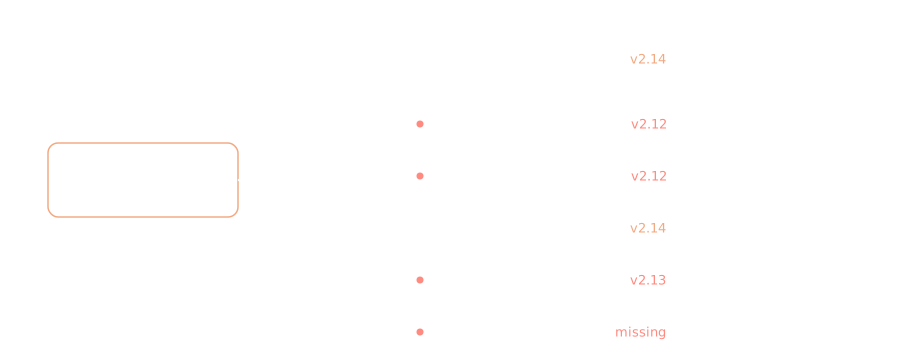
The consequences are concrete. An agent that finds a clear, current page cites it. An agent that finds no page, or a stale one, answers anyway from general knowledge and attaches your product’s name to the answer. A developer then writes code against old behavior. When an agent cannot get what it needs from your docs, it uses another product’s.
What we do about it
Making the docs agent-readable once is not enough. Your product keeps changing, and the page does not, so the agent writes code against old behavior. The standards for agent access keep changing too. WebMCP is recent. llms.txt is young. Nobody knows which standard will last. A site that met last year’s standard may not meet this year’s, and betting on a single one is a bet against a field that is still moving.
We handle both. We build every agent-facing surface for every site. We regenerate all of them whenever the docs change, and we update the docs after every product release. We watch for new agent access standards, test them, and deploy them across every customer site. You never have to track which standard is winning. You approve changes before they publish.
Docs are the kind of rich content AI agents trust and cite. Docs are the new growth channel. If you want to see what your docs look like to an agent, we should talk.