22 source pages
Task guides, troubleshooting, frequently asked questions, release notes, and developer material in MDX.
Your Company is a fictional contract platform built to demonstrate the real SaturnDocs reader experience without using customer content or making a customer-result claim.
The public demo shows a complete SaturnDocs site generated from fictional product context: 22 authored pages, an 18-operation OpenAPI specification, search across 40 published pages, an interactive API reference, a source-grounded AI assistant with citations, release notes, llms files, Markdown exports, and responsive navigation.
Open the live Your Company documentation demo. The notice on its home page and footer identify it as fictional.
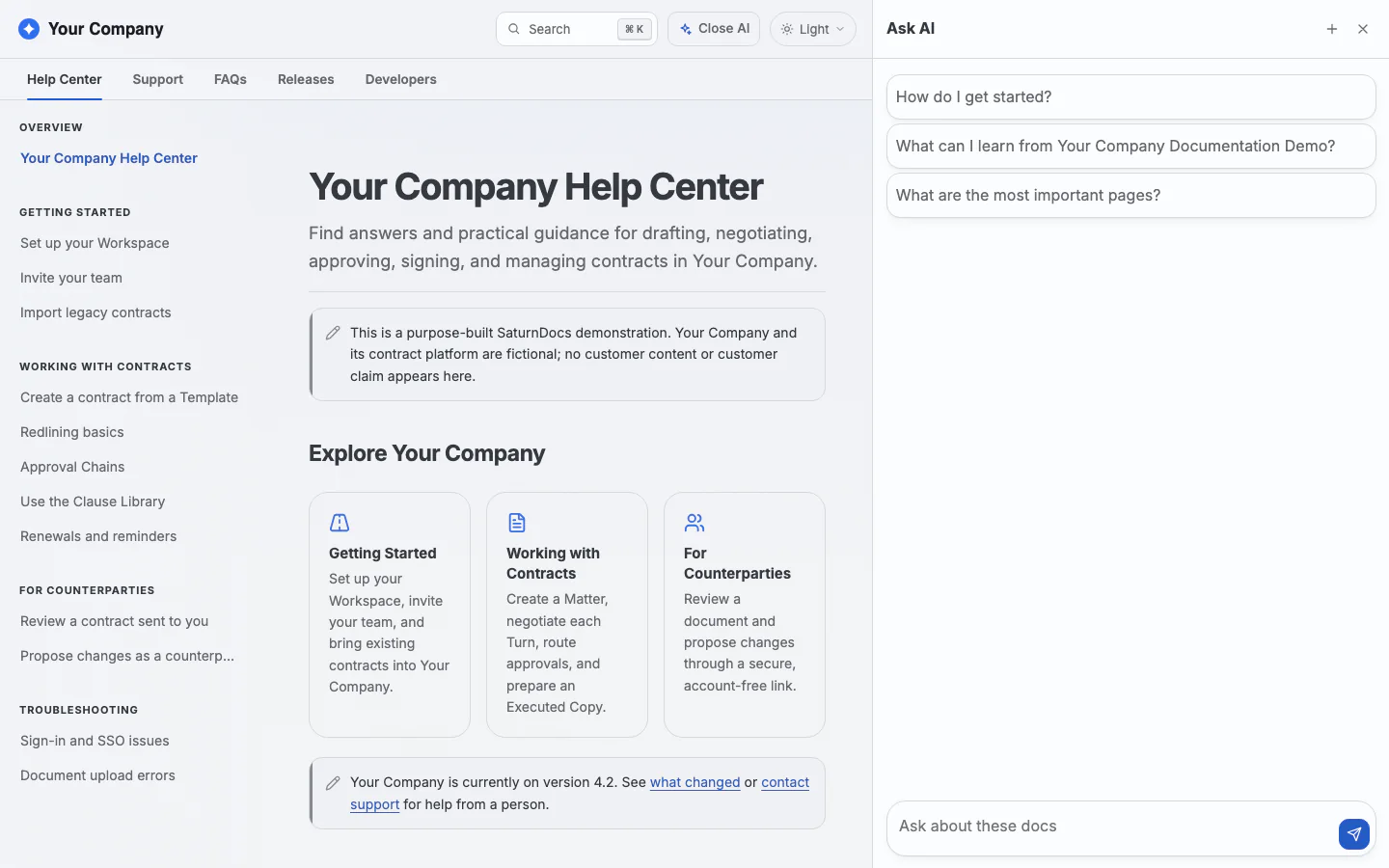
The demo began with the same portable source shape used by SaturnDocs customers: a small configuration file, MDX pages, brand assets, model behavior settings, and an OpenAPI specification. The fictional material describes contract workflows deeply enough to test guides, troubleshooting, release notes, a developer section, and an API reference together.
Task guides, troubleshooting, frequently asked questions, release notes, and developer material in MDX.
Matters, documents, turns, clauses, approvals, and webhooks described in OpenAPI 3.1.
Navigation, branding, appearance, assistant behavior, footer, and the canonical site URL.
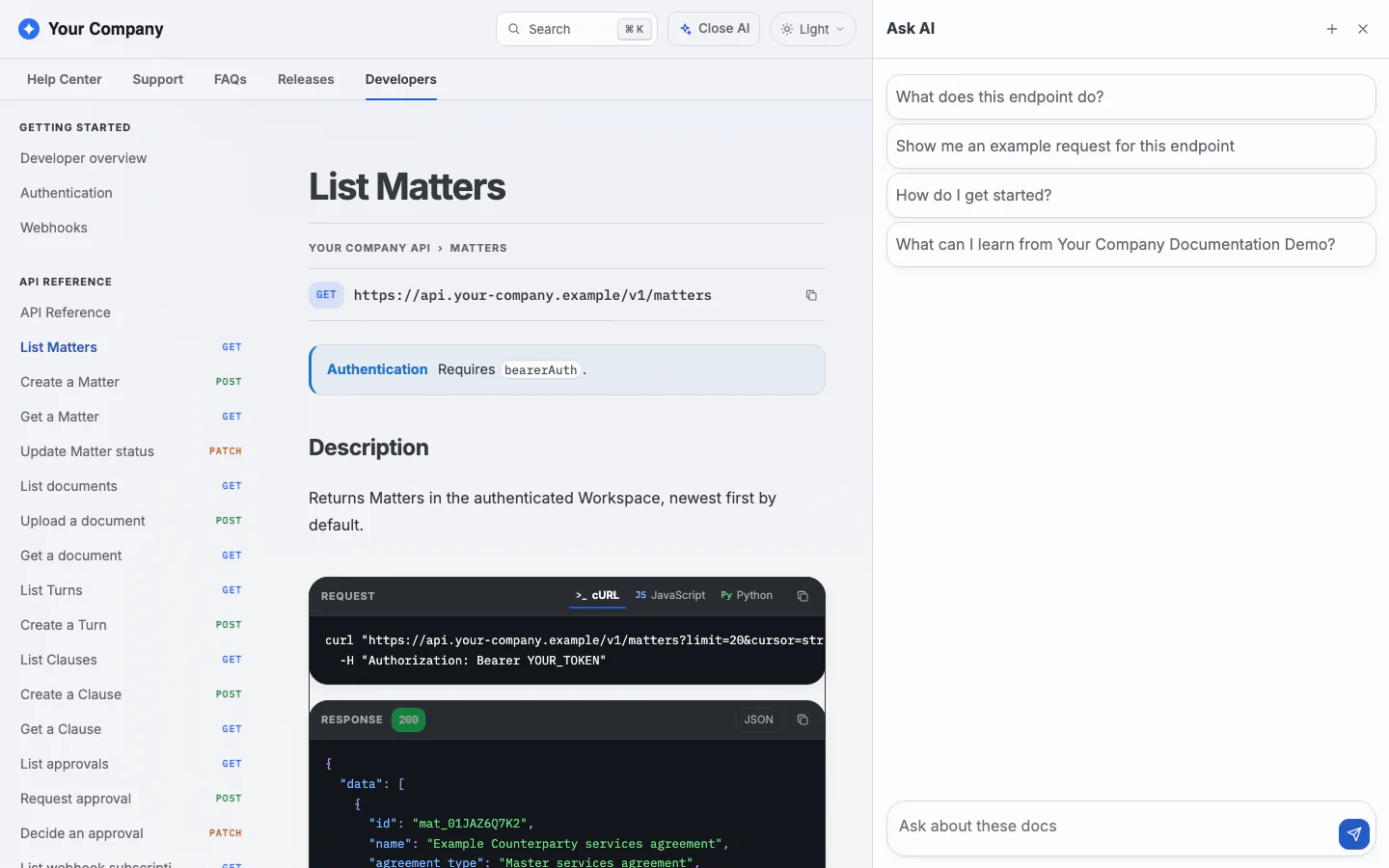
Each OpenAPI operation becomes a native reference page with the method and path, authentication requirements, parameters, request and response examples, schemas, and language-specific request samples. The reference shares the persistent shell, search, assistant, theme, and navigation with the authored guides.
Inspect the live List Matters operation or start from the API reference overview.
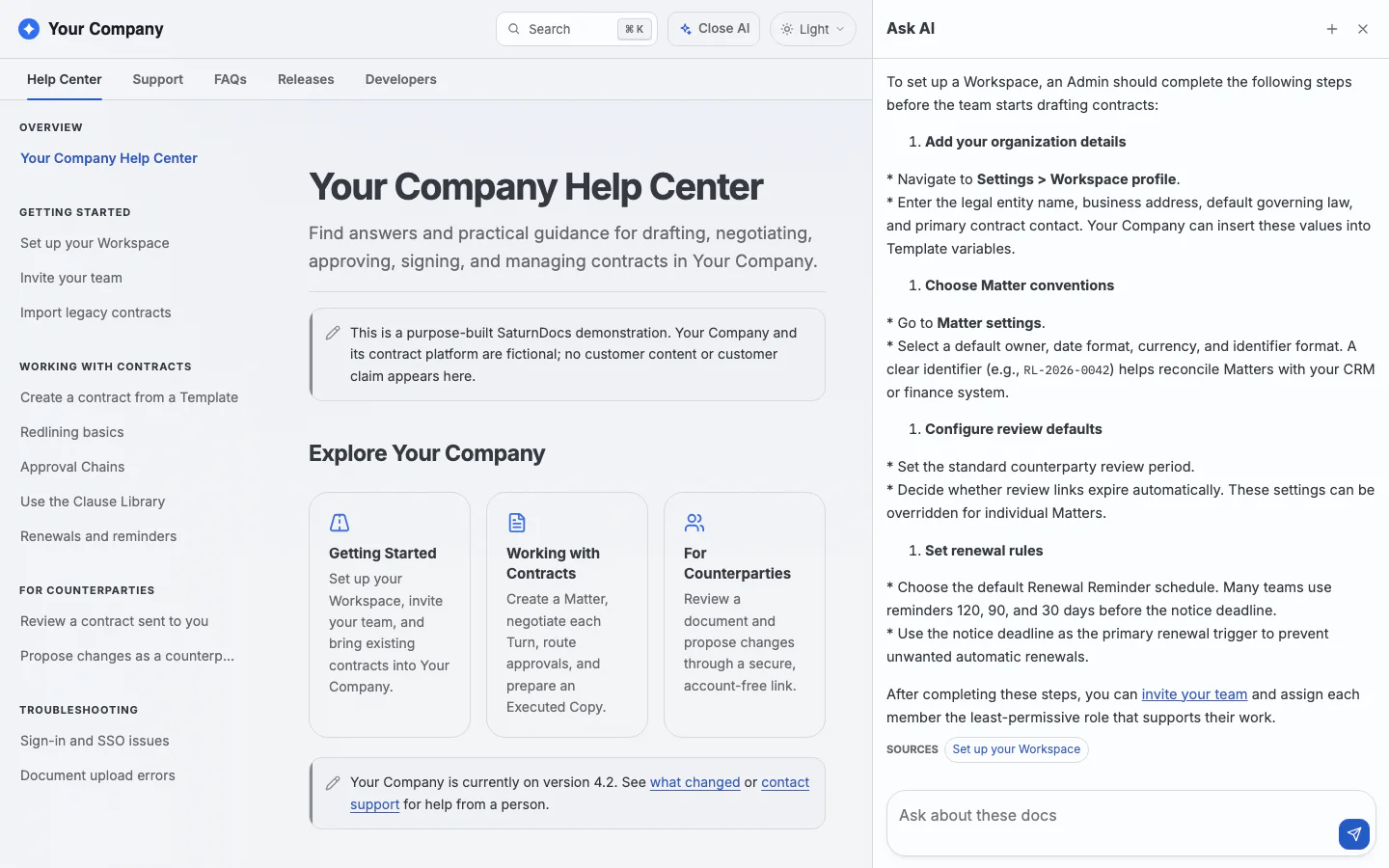
Yes. On July 29, 2026, the live assistant was asked how to set up a Workspace. It returned the four documented setup steps, linked the next invitation task, and cited the Set up your Workspace source page. The assistant endpoint returned HTTP 200 and the cited links resolved to the published demo.
Read the source page, then ask the same question in the live demo.
The demonstration publishes the same content through a concise llms index, consolidated llms-full context, Markdown versions of the authored pages, and an XML sitemap. These files are generated from the source bundle during the same gated build that produces the human-readable site.
The demo proves that the current renderer and hosting platform produce and serve the documented reader, API, search, assistant, and machine-readable surfaces from a realistic fictional source bundle. It does not prove a customer outcome, migration speed, conversion improvement, support deflection, or return on investment. Those claims require a real approved case study.
The boundary is deliberate. This page labels generated evidence as generated evidence instead of presenting a fictional product as a customer success story.
No. Your Company is fictional. The site is a purpose-built demonstration created from fictional product material, and it contains no customer content, customer identity, testimonial, or customer-result claim.
The source bundle contains 22 MDX pages, one docs configuration file, brand assets, model behavior settings, and an OpenAPI specification with 18 operations. The same type of bundle SaturnDocs uses for customer sites produced the live demonstration.
Yes. The live assistant answers from the published fictional documentation and cites the supporting pages. The proof page records a verified question about setting up a Workspace and shows the resulting cited answer.
Yes. The live demo exposes llms.txt, llms-full.txt, Markdown page versions, and its sitemap. Links to those files appear on this page and in the demo itself.